PREVIOUS
NO MORE



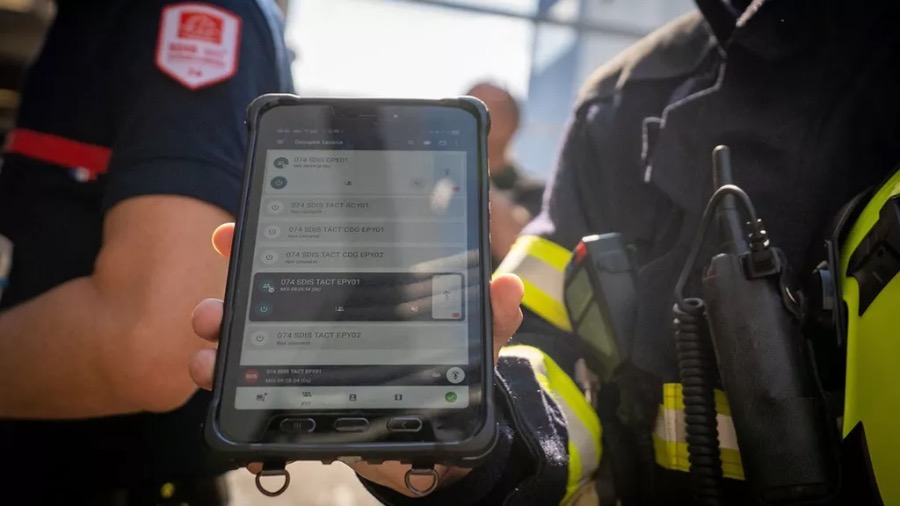
The Future Radio Network (RRF) will provide French security and emergency services with a single, secure, high-speed communications platform. The objective is to enable the relevant services to carry out their missions under all circumstances. The Antarès and Storm telecommunications networks, deployed across France for security and emergency services, are now approaching the end of their operational lifecycles. They are gradually being replaced by the new Future Radio Network (RRF), an autonomous very-high-speed network developed and operated by ACMOSS, with the support of Airbus and Capgemini. To achieve this, the public agency, established specifically for this purpose in 2023, is relying on the 4G/5G antenna network operated by Bouygues Telecom and Orange, with nationwide roaming also possible via the SFR and Free networks.
“Since June 2025, we have used the RRF for more than 6,000 interventions involving secure and prioritized communications, as well as for other applications such as navigation, access to operational mapping and the completion of patient casualty assessments,” says Gilles Dubos, Lieutenant-Colonel with the SDIS (Departmental Fire and Rescue Service) of Haute-Savoie. The cross-border region is an ideal environment for testing the system, as “it combines mountainous areas and densely populated urban zones, road tunnels, lake areas and other more isolated locations.”
Today, the RRF has been deployed at 4 of the 80 centres in this Alpine department (in conjunction with the emergency call handling centre), and by next April it will be extended to all sites and the 700 personnel concerned locally. “We are still finalising the equipment and accessories needed to connect and rapidly recharge portable devices inside vehicles,” Gilles Dubos continues. “The issue of establishing radio communications with personnel located in coverage blackspots also remains to be resolved.” “Today, we have 10,000 operational RRF subscribers. Within the Police and Gendarmerie, for example, 3,500 personnel have already migrated to the RRF from Storm, their 4G network created in 2016 with Orange,” explains Rémi de Gouvion Saint-Cyr, Director of Acmoss. However, the scope of deployment is not limited. Municipal police forces are free to join the RRF, as are local authorities, operators of vital importance and private organisations holding public service concessions.
Among the other current users are 3,000 personnel from the Interdepartmental Road Directorates (DIRs); the remaining third is made up of personnel from the Ministry of the Armed Forces, SDIS departments, municipal police forces, SAMU emergency medical services, prefectures and other organisations. “By the end of 2026, we will expand this user base with the arrival of an additional 70,000 police officers and gendarmes. RATP and the Customs authorities are also making good progress. By 2029, we are targeting 300,000 users in order to achieve budgetary equilibrium,” adds the Director of Acmoss.
“In terms of audio quality, the RRF is incomparable, and all digital applications are facilitated. For example, we can create as many conference groups as required, either between different services or with command centres, in order to deploy the appropriate resources,” notes Lieutenant-Colonel Dubos. Today, usage patterns are changing: the RRF enables users to exchange photographs of wanted or injured persons, distress voice recordings, a PDF showing a burning building, or a video stream captured by a drone, thereby enhancing the effectiveness of ongoing emergency operations.
The change in concept is no longer limited to voice transmission — previously the only available capability — but instead centres on integrating operational data in all its forms into the RRF, including voice, geolocation, photographs, video, streaming and text. All of this is built around a secure terminal that brings together the full range of 250 business-specific applications used by the relevant user communities.
Beyond this, every user has access to Syrius, an application dedicated to mission-critical operations that enables communications to be given priority, as well as the Atria application, which continuously monitors the quality level of the four networks in order to obtain the best available connectivity, including when using international roaming. To guarantee the availability and security of the entire system, all network metrics and components are monitored by Acmoss's Network Operations Centre (NOC), which employs around 100 personnel.
The overall operation — including network construction, network operations and operation of the agency — requires a budget of €890 million (2022–2030). “As a public agency, Acmoss does not generate profits. The revenues also make it possible to finance innovations designed to enhance the RRF for the benefit of all its subscribers,” concludes Rémi de Gouvion Saint-Cyr.